
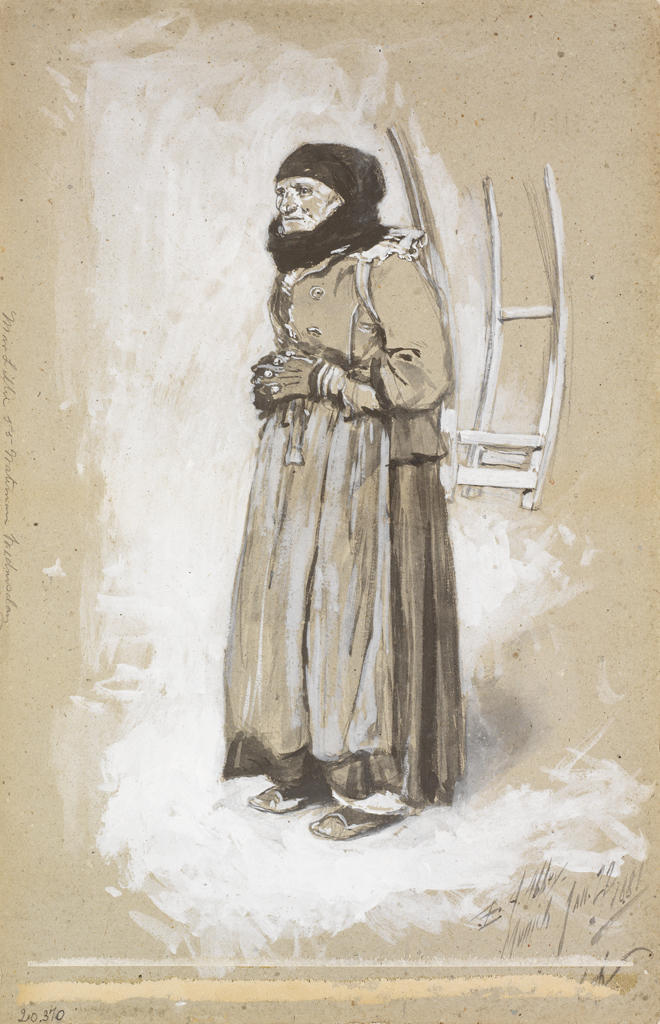
Edwin Austin Abbey
American, 1852-1911
Old Peasant Woman, 1881
Brush and ink and opaque watercolor on cardboard
Sight: 50.5 x 27.6 cm (19 7/8 x 10 7/8 inches)
Gift of Mrs. Gustav Radeke 20.370
Edwin Austin Abbey’s ambition to become a painter was held in check during the 1870s when his considerable talent as an illustrator provided him with a successful livelihood. Born in Philadelphia, Abbey trained briefly as a teenager under Christian Schussele at the Pennsylvania Academy of the Fine Arts, but his concurrent apprenticeship in a local publishing house set the stage for his career as a draftsman. By 1871 Abbey had moved to New York to work at Harper & Brothers under the art direction of Charles Parsons.1 Here he combined an incisive skill for narrative with a passion for using costumes and accessories to enhance historical accuracy. At Harper, he was credited with raising the level of illustration by insisting on doing careful work from the model and from nature.2
Abbey submitted a painting to the debut exhibition of the American Watercolor Society in 1874, but like many of his young colleagues in New York, he lamented the limitations of the “artistically barren existence that was ours in the early ‘seventies.’”3 He later recalled the importance of an 1875 exhibition of British drawings that introduced him to George Du Maurier’s work in India ink and to the watercolors of G. J. Pinwell.4 Through his friend Francis Lathrop, Abbey was introduced to the illustrations of Dante Gabriel Rossetti, William Holman Hunt, and Ford Madox Brown, and he also searched English art periodicals for drawings by artists such as Charles Keene and John Everett Millais.5 What Abbey described as the “great eye-opener” in his young life as an artist came at the 1876 Centennial Exhibition in Philadelphia, where he discovered contemporary European painting, in particular the work of Frederic Leighton, George Frederic Watts, and Luke Fildes. Years later, he said he could still close his eyes and remember every painting in the British section at the fair.6
Abbey’s friendships with Harper artists C. S. Reinhart, who had studied in Germany, and Will H. Low, who left for Paris in 1873, intensified a longing to study abroad. His desire was compounded by the enthusiasm of William Merritt Chase, who returned from Munich to teach at the Art Students League in 1877 and joined Abbey’s group, the Tile Club, for their excursion the following summer.7 Presented with a commission to illustrate the poetry of Robert Herrick for Harper, Abbey seized an opportunity to research authentic backgrounds and atmosphere and sailed for London in the fall of 1878.
Although Abbey would become renowned for his historical and literary subjects, he was keenly aware of realist and naturalist themes. In London, he was astonished by the wretched condition of the urban poor, and remarked on their accurate portrayal in the Dickens illustrations of John Leech and in Luke Fildes’s 1874 painting Applicants for Admission to the Casual Ward.8 Similarly, he was drawn to the rural subject matter of Jules Bastien-Lepage’s Potato Harvest9 when he visited the Paris Salon for the first time in 1879. Like many young painters, he was profoundly moved the following year by Bastien-Lepage’s Joan of Arc,10 and described the “life-sized figure of a coarsely and vulgarly moulded peasant girl” as “the very greatest picture ever painted by anybody since the fifteenth century.” It provoked in him “the wild longing … to grab a brush and set my teeth and paint until I dropped dead.”11 This artistic desire remained unfulfilled for the next few years, but in the interim Abbey took steps to develop his painting technique.
In December of 188012 , Abbey and John Lillie, an American translator of French texts, traveled to Munich, where Lillie’s wife was suffering from peritonitis. Both John and Lucy Cecil White Lillie13 , a writer who did research for Harper, were Abbey’s close friends and had nursed him during a recent illness. John Lillie shared Abbey’s interest in costume, while Lucy planned to collaborate with him on an article on the picturesque county of Surrey14 . Although he had only recently returned to London from a sketching trip in Holland with the artist George Boughton, Abbey decided to stay in Munich for a few weeks in order to visit the galleries and to take some lessons in painting. Through Charles Mente, a friend from the Harper art department, Abbey applied to the studio of history painter Wilhelm von Diez, a professor at the Royal Academy. When Diez was unable to accommodate him, Abbey requested a lesson from Diez’s student Alois Erdtelt, who was known as a “good painter of heads.15 ” It was Erdtelt who offered Abbey the subject for his Old Peasant Woman.
According to Mente: “We took our stretchers to Erdelt [sic] on the day appointed. The model was an old woman, and at Abbey’s request Erdelt painted also, as he wanted to see him work.”16 Although there is no documentation of Abbey’s progress in oil that day, Old Peasant Woman records his acute observation of the model in the medium in which he was most adept: the monochrome washes used by illustrators to create copy for wood engravers. He drew the figure on a large sheet of tan board, sketching her first in pencil then painting her costume with washes of brown, black, and Chinese white. Great attention was given to describing her costume, which consisted of a black knitted cap and scarf, short jacket with peplum, and long skirts and apron. Abbey skipped no detail of her accessories, carefully recording her fingerless gloves, felt shoes, and incongruous white collar. Her arduous work as a faggot-gatherer is indicated by the wooden frame she wears on her back.
Abbey’s characterization of the old woman profited from his thorough study of the paintings of Holbein and Ribera in the Alte Pinakothek. Unlike that of many illustrators, his talent extended beyond the definition of physical properties. His masterful treatment of the woman’s ruddy, wizened face—inspired, perhaps, by Erdtelt’s proficiency—reveals a realist’s sensitivity to her social condition and an ability to render a keen psychological portrait. Exposure to contemporary French and German painting, as well as to the Dutch and Spanish masters in the picture galleries of Europe, had already contributed to Abbey’s growth as an artist. In Old Peasant Woman, he began to surpass his journalistic skills, putting his sharp eye for costume to the service of portraying the model’s experience and station in life.
Landscape and Leisure: 19th-Century American Drawings from the Collection is on view at the RISD Museum from March 13 – July 19, 2015.
Maureen O’Brien
Curator of Painting and Sculpture
- 1Parsons was head of the art department at Harper & Brothers from 1863 through 1889, and had previously worked as an artist for Currier and Ives. See Charles Parsons and His Domain: An Exhibition of Nineteenth Century American Illustration (Montclair, NJ: Montclair Art Museum, 1958) and Eugene Exman, The House of Harper: One Hundred and Fifty Years of Publishing (New York: Harper and Row, 1967).
- 2E. V. Lucas, Edwin Austin Abbey, Royal Academician; The Record of His Life and Work (2 vols.) (London: Methuen and Company, Ltd., 1921) I, 45.
- 3Lucas, I, 25.
- 4Lucas, I, 38, describes this exhibition of drawings and watercolors that was brought to the United States by Henry Blackburn.
- 5See Michael Quick, “Abbey the Illustrator,” in Edwin Austin Abbey (1852–1911): An Exhibition Organized by the Yale University Art Gallery (New Haven: Yale University Art Gallery, 1973) for a discussion of the influences on Abbey’s work as an illustrator.
- 6Lucas, I, 47, quotes an unposted letter from Abbey to Will H. Low in which he describes the Centennial: “That show had an ‘Art Section’ which was really a great one. England’s exhibit was to my mind by far the most interesting and inspiring—and I can close my eyes now and see nearly every picture in it … Leighton’s ‘Summer Moon’ and ‘House in Damascus,’ Watts’s portraits of Leighton and Millais; Fildes’s ‘Casuals.’”
- 7The Tile Club was founded by Abbey and his friends in the fall of 1877. Its members chronicled their activities in articles for Scribner’s Monthly and The Century Magazine. The early events were described by W. MacKay Laffan and Edward Strahan [Earl Shinn] in “The Tile Club at Play,” Scribner’s Monthly, vol. 17, no. 34 (February 1879), 457–78.
- 8Lucas, I, 63–64. Luke Fildes, Applicants for Admission to a Casual Ward, 1874, Royal Holloway College, Surrey, UK. https://www.royalholloway.ac.uk/archives/itemofthemonth/items/december2013.aspx
- 9Jules Bastien-Lepage (1848–84), Potato Gatherers (Saison d’octobre, récolte des pommes de terre), 1878, National Gallery of Victoria, Melbourne. http://www.ngv.vic.gov.au/explore/collection/work/3768/
- 10Joan of Arc (Jeanne d’Arc), 1879, Metropolitan Museum of Art, New York, Gift of Erwin Davis. http://www.metmuseum.org/toah/works-of-art/89.21.1
- 11Lucas, I, 103, Abbey to Charles Parsons, May 31, 1880.
- 12Kathleen A. Foster, Makers of the American Watercolor Movement: 1860–1890 (dissertation, Yale University, 1982), 285, notes Abbey’s recognition at home, citing that his drawings were on exhibition at the third exhibition of the Salmagundi Club in New York in December 1880–January 1881, and that he was elected to the Society of American Artists in January 1881.
- 13An inscription on the left edge of the sheet, “Mrs Lillie 55 Waterman Wednesday,” perhaps written by a picture framer, suggests that it was once owned by Lucy Cecil White Lillie, whom Abbey was visiting in Munich when he made the drawing. In Providence, Mrs. Lillie may have stayed at 55 Waterman Street in The Paxton, a genteel Providence boarding house near Brown University, around 1891. That year, Margaret A. Gardner, a local music teacher, published a 20-page study guide to accompany Lillie’s popular volume The Story of Music and Musicians for Young Readers (New York, Harper & Brothers, 1886). By 1904, the drawing was in the collection of a Providence physician, Dr. Mary Denison Moss, and was sold to Mrs. Radeke from Dr. Moss’s estate by her son, William Washburn Moss.
- 14In 1882, Lucy Lillie published Mildred’s Bargain and Other Stories (New York and London: Harper & Brothers). Eight of Abbey’s drawings—notably, a group of complex interior scenes with carefully modeled figures—appear as illustrations. At the time of his friendship with Abbey, John Lillie was translating Challamel’s Histoire de la mode en France (The history of fashion in France, or, The dress of women from the Gallo-Roman period to the present time) from the French (New York: Scribner and Welford, 1882).
- 15Lucas, I, 110. Erdtelt (1851–1911) also painted genre subjects, but was best known as a portrait painter, specializing in women and girls. See Horst Ludwig, et al., Münchener Maler im 19. Jahrhundert, I, (Munich: Bruckmann Verlag, ca. 1981), 302–3.
- 16Lucas, I, 110.