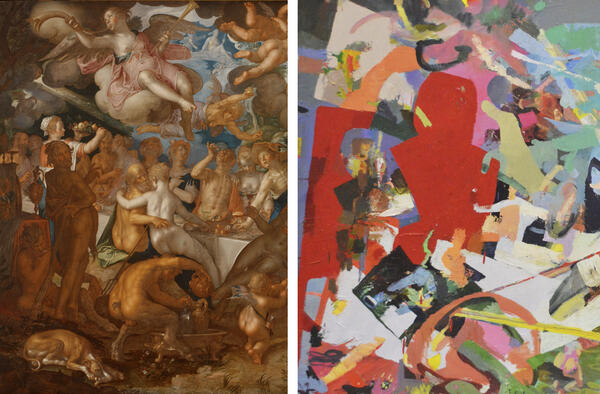
Inspired by Joachim Antonisz Wtewael's "The Marriage of Peleus and Thetis," Josephine Devanbu (RISD/Brown 2015) uses the painting's shapes and density in her newest work.
Students in Mariela Yeregui's Decolonial E-Textiles class create radical, critical, situated, and anticolonial projects that combine textile techniques with simple and low-tech electronic mechanisms.
Why is an Etruscan situla, or pail, one of the most important objects in RISD's ancient collection? We examine its form, decoration, and context to understand its unique place in European archaeology.
The American and European jewelry collection at the RISD Museum, part of the Decorative Arts and Design Department, is made up of more than 800 works, including necklaces, earrings, bracelets, and rings from the medieval period to present day.
An exploration of the intriguing relationships between works in Martin Boyce's mid-career survey exhibition at the RISD Museum and objects by Alexander Calder, Charles and Ray Eames, and Dan Flavin in the museum's collection.
How do you lay an Egyptian mummy to rest in a museum? Our curator considered a number of factors in orienting Nesmin, RISD's Egyptian mummy, in his new case in the freshly renovated gallery, but found a strange coincidence in her final decision.
A chance meeting between the wife of President Rutherford B. Hayes and Theodore Davis, an illustrator and journalist for "Harper's Weekly", in the White House conservatory produced one of the most extraordinary dinner services.
Five works on paper in the RISD Museum’s collection follow the arc of Charles Burchfield’s career, introducing and reprising themes that reveal his desire for artistic unity with nature.
Luca Cambiaso used iron gall ink and a quill pen to create this drawing in about 1570. RISD professor Andrew Raftery walks us through the making of iron gall ink and a quill pen, and explains how he copied Cambiaso's drawing.
Unfinished paintings by Eastman Johnson, John Singer Sargent and Mary Cassatt reveal new techniques that emerged in France in the second half of the 19th century.