During the Fall of 2015, Sheila Bonde’s graduate students in the Department of the History of Art and Architecture at Brown University undertook an investigation of the wood sculptures in the RISD Museum collections. This multi-author paper includes some of their findings.
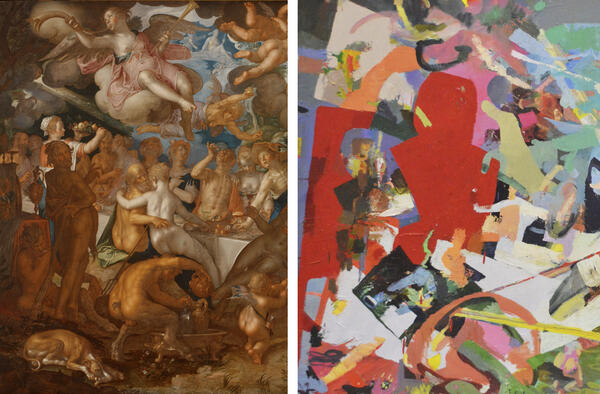
Inspired by Joachim Antonisz Wtewael's "The Marriage of Peleus and Thetis," Josephine Devanbu (RISD/Brown 2015) uses the painting's shapes and density in her newest work.
In the Middle Ages, several saints were represented as knights in art, making it difficult to identify RISD’s Crusading Saint. This article will explore his possible identities.
Pixilation Party!, or how, with the help of dozens of RISD Museum visitors, Providence artist Xander Marro recently created one minute of black and white magic.
How do we describe images and the experience of looking at images? Student Grace Xiao reflects on the process of writing alt text for "Variance: Making, Unmaking, and Remaking Disability."
RISD Museum Summer researcher discusses Wifredo Lam's 1959 painting Près des Îles Vierges as a reflection of his complicated relationship with revolutionary Cuba and evolving understanding
Editor of publications Amy Pickworth, intern Joanna Cortez, and curatorial assistant of contemporary art A. Will Brown interview UuDam Tran Nguyen about his single channel video Waltz of The Machine Equestrians--The Machine Equestrians (2012).
Architect James Stanton-Abbott explains his process for creating a computer-rendered reconstruction of a room in an ancient Roman villa near Pompeii, using images of wall-painting fragments in the RISD Museum and the MFA, Boston.
The discovery of these treasures resembles that of a valuable manuscript. They are a new “Codex Africanus,” not written on fragile papyrus, but in ivory and imperishable brass.
In 1971, a group of radical students in Providence produced stirring silkscreen posters. Their images contributed to the vibrant visual culture of antiwar protest.
The handmade object has a tendency to prompt memories from the craftsperson who made it. In this reflection on an embroidered purse from the 1970s, Ariel Wills and Kate Irvin are joined by maker Christina Bevilacqua for a dynamic conversation that demonstrates the narrative qualities embodied in material culture.