Digital Initiatives intern Ariel Hirschhorn explores the “Maker” field in the museum’s database to examine the collection from a programmer’s perspective
Painting student Davis Lloyd recollects stumbling across an unlikely source of inspiration, and connection between ancient art and contemporary painting.
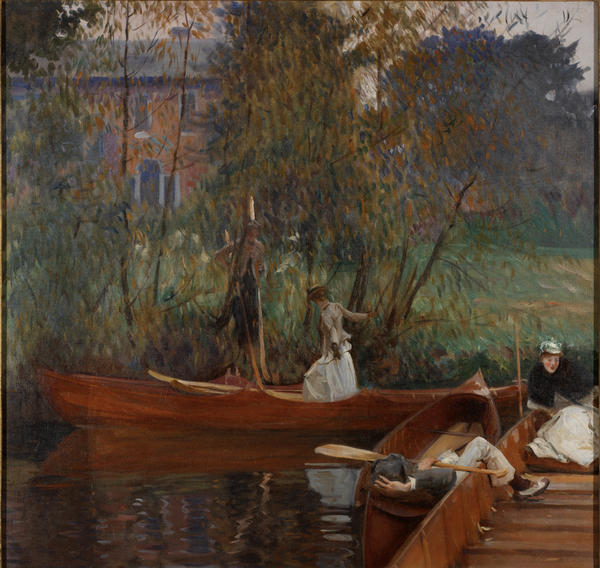
Unfinished paintings by Eastman Johnson, John Singer Sargent and Mary Cassatt reveal new techniques that emerged in France in the second half of the 19th century.
William Stanley Haseltine first studied painting in Philadelphia with the German expatriate Paul Weber, who encouraged him to continue his training in Düsseldorf.Haseltine attended the Univer
RISD's ancient art collection includes a vase that demonstrates how one Greek potter perfected international marketing and became one of the most prolific artisans in ancient Athens.
Editor of publications Amy Pickworth, intern Joanna Cortez, and curatorial assistant of contemporary art A. Will Brown interview UuDam Tran Nguyen about his single channel video Waltz of The Machine Equestrians--The Machine Equestrians (2012).
Arlene Shechet discusses the production of works for and the installation design of Arlene Shechet: Meissen Recast with the exhibition's curator, Judith Tannenbaum.
Albert Bierstadt was born in Solingen, Germany, but came to the United States with his family in 1832 and settled with them in New Bedford, Massachusetts.
Juxtaposing Iké Udé’s photography with Sun Ra’s notions of "mythocracy" and Black Utopia, Ann-Maree Quaynor seeks to reclaim Black Dignity and Existence.
Childe Hassam, a successful young book and magazine illustrator, made his first trip abroad in 1883, disembarking in Great Britain then making a wide sweep through France, Holland, Switzerlan
Unfinished paintings by Eastman Johnson, John Singer Sargent and Mary Cassatt reveal new techniques that emerged in France in the second half of the 19th century.
Unfinished paintings by Eastman Johnson, John Singer Sargent and Mary Cassatt reveal new techniques that emerged in France in the second half of the 19th century.
Books of hours made during the late Middle Ages and Renaissance were products of collaboration between scribes, illuminators, bookbinders, and, sometimes, the original patron or owner. A recent acquisition of a French book of hours made in Rouen around 1510 tells the story of this collaboration through the structure of its contents, iconography, and assembly.
Richard Merkin was for decades the go-to authority for all things dandyish. As we see in the ephemera from his life and his tailored clothing on view in the exhibition "Artist/Rebel/Dandy", his personality and fashion sense live on at RISD.