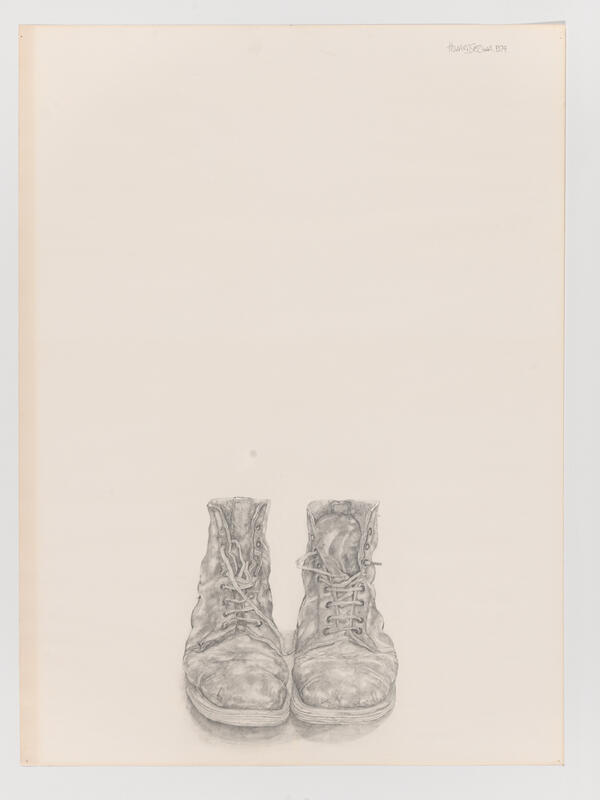
The RISD Museum’s 2009 acquisition of the Richard Brown Baker collection included two drawings by the English artist Howard Selina—Cowboy Hat (1974) and Two Boots (1974)—carefully and precisely rendered drawings in graphite on paper of well-worn, utilitarian garments.
In the flood of digital-ness that comprises our daily experience, it can be easy to forget that most of what all of our complex devices are doing is simply counting. It's no coincidence that the word digital comes from digits, our fingers, that most elementary of counting machines.
The woman in Frank W. Benson's Lady Trying on a Hat has always been a character who caught my eye during visits to the Museum. From her averted gaze to the contrast between her white dress and the black hat, she is poised to play the lead role on the stage that Benson created.
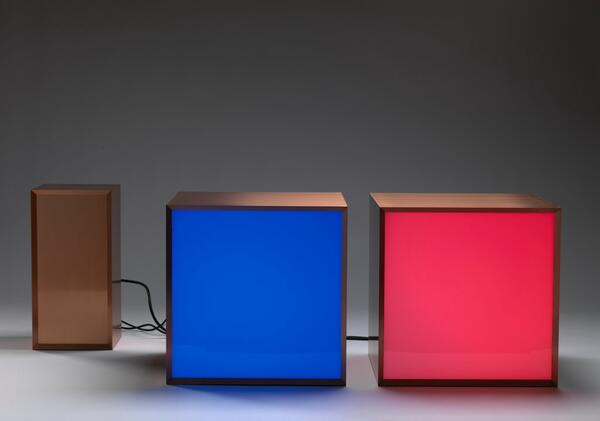
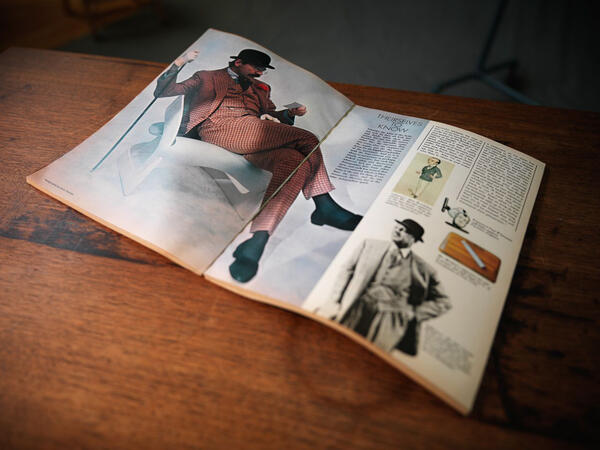
RISD Museum object photography generally follows typical museum practice: a straightforward approach to framing and lighting with great concern for color fidelity. For *Artist/Rebel/Dandy*, the curators suggested that we go in a different direction.
Albert Bierstadt was born in Solingen, Germany, but came to the United States with his family in 1832 and settled with them in New Bedford, Massachusetts.
Isabella McCormick (Brown/RISD 2015) explores the intricacies of the Gorham Narragansett Salad Set and their reflections on Rhode Island culture, insights gained from her meticulous cleaning of the utensils as part of her Mellon Summer Internship in conservation.
Curatorial intern Grace Xiao reflects on viewing artwork that embraces instability, disruption, and restlessness, making room for open interpretations in the gallery.
A student in a RISD course on pan-African aesthetics contemplates a vinyl record pictured in a Sanlé Sory photograph in the collection, and imagines the songs it contains.
A rare female artist, Diana Mantuana's engraving of Atilius Regulus in a Barrel plays an important role in the history of the practice of printmaking and its reception in Renaissance Italy.
An exploration of the intriguing relationships between works in Martin Boyce's mid-career survey exhibition at the RISD Museum and objects by Alexander Calder, Charles and Ray Eames, and Dan Flavin in the museum's collection.