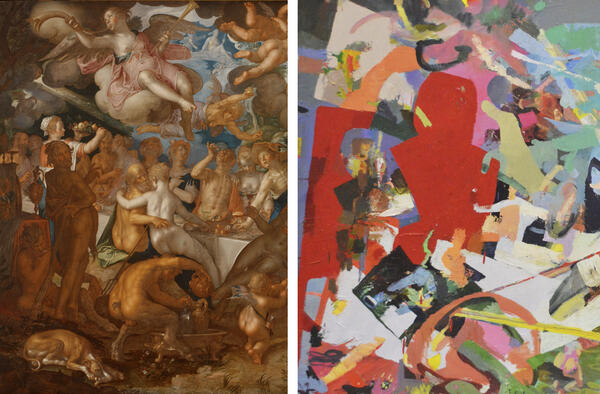
Inspired by Joachim Antonisz Wtewael's "The Marriage of Peleus and Thetis," Josephine Devanbu (RISD/Brown 2015) uses the painting's shapes and density in her newest work.
Why is an Etruscan situla, or pail, one of the most important objects in RISD's ancient collection? We examine its form, decoration, and context to understand its unique place in European archaeology.
This article explores the concept of purity in criticisms of Inuit prints by briefly introducing the history of printmaking in Cape Dorset and looking at 1970s Western art historians' expectations of Inuit art.
How do you lay an Egyptian mummy to rest in a museum? Our curator considered a number of factors in orienting Nesmin, RISD's Egyptian mummy, in his new case in the freshly renovated gallery, but found a strange coincidence in her final decision.
Five works on paper in the RISD Museum’s collection follow the arc of Charles Burchfield’s career, introducing and reprising themes that reveal his desire for artistic unity with nature.
The future is an abstract concept, hard to decode and difficult to predict. A summer intern reflects on fashion and future in this creative writing piece.
Over the last 2,000 years, Nesmin has been a priest, a mummy, and a museum exhibit. RISD Museum intern Jonathan Migliori discusses Nesmin's influence in his life.
A summer intern meditates on the medium of murals and how they appear on RISD’s walls, using Photoshop to understand what is lost when seeing incomplete works out of context.
The Museum recently acquired *Huevos de Los Angeles*, a collaborative work by two RISD alumni, Adam Silverman and David Wiseman. Here the artists describe how they created "eggs" to rival the most coveted variety.
A student in a RISD course on pan-African aesthetics, inspired by a photograph in the collection, explores Black youth occupying space in movements from La Sape to Noirwave.