During the Fall of 2015, Sheila Bonde’s graduate students in the Department of the History of Art and Architecture at Brown University undertook an investigation of the wood sculptures in the RISD Museum collections. This multi-author paper includes some of their findings.
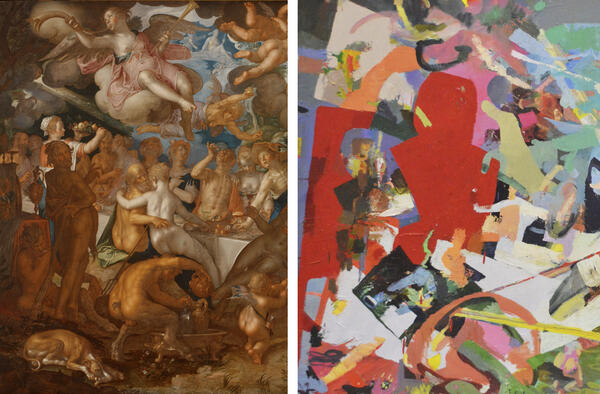
Inspired by Joachim Antonisz Wtewael's "The Marriage of Peleus and Thetis," Josephine Devanbu (RISD/Brown 2015) uses the painting's shapes and density in her newest work.
Why is an Etruscan situla, or pail, one of the most important objects in RISD's ancient collection? We examine its form, decoration, and context to understand its unique place in European archaeology.
How do you lay an Egyptian mummy to rest in a museum? Our curator considered a number of factors in orienting Nesmin, RISD's Egyptian mummy, in his new case in the freshly renovated gallery, but found a strange coincidence in her final decision.
Five works on paper in the RISD Museum’s collection follow the arc of Charles Burchfield’s career, introducing and reprising themes that reveal his desire for artistic unity with nature.
Luca Cambiaso used iron gall ink and a quill pen to create this drawing in about 1570. RISD professor Andrew Raftery walks us through the making of iron gall ink and a quill pen, and explains how he copied Cambiaso's drawing.
Unfinished paintings by Eastman Johnson, John Singer Sargent and Mary Cassatt reveal new techniques that emerged in France in the second half of the 19th century.
Books of hours made during the late Middle Ages and Renaissance were products of collaboration between scribes, illuminators, bookbinders, and, sometimes, the original patron or owner. A recent acquisition of a French book of hours made in Rouen around 1510 tells the story of this collaboration through the structure of its contents, iconography, and assembly.
The future is an abstract concept, hard to decode and difficult to predict. A summer intern reflects on fashion and future in this creative writing piece.
This late fifteenth-century Virgin and Child was created with subtlety, flexibility, and portability in mind. These features were central to its medieval use—and its use at the RISD Museum.
Over the last 2,000 years, Nesmin has been a priest, a mummy, and a museum exhibit. RISD Museum intern Jonathan Migliori discusses Nesmin's influence in his life.
How do we describe images and the experience of looking at images? Student Grace Xiao reflects on the process of writing alt text for "Variance: Making, Unmaking, and Remaking Disability."
A summer intern meditates on the medium of murals and how they appear on RISD’s walls, using Photoshop to understand what is lost when seeing incomplete works out of context.