Marking the Museum’s entrance into online publishing, Altered States: Etching in Late 19th-Century Paris combines a scholarly collection of essays with a video glossary of printmaking techniques.
William Stanley Haseltine first studied painting in Philadelphia with the German expatriate Paul Weber, who encouraged him to continue his training in Düsseldorf.Haseltine attended the Univer
How do we describe images and the experience of looking at images? Student Grace Xiao reflects on the process of writing alt text for "Variance: Making, Unmaking, and Remaking Disability."
RISD Museum object photography generally follows typical museum practice: a straightforward approach to framing and lighting with great concern for color fidelity. For *Artist/Rebel/Dandy*, the curators suggested that we go in a different direction.
Albert Bierstadt was born in Solingen, Germany, but came to the United States with his family in 1832 and settled with them in New Bedford, Massachusetts.
Curatorial intern Grace Xiao reflects on viewing artwork that embraces instability, disruption, and restlessness, making room for open interpretations in the gallery.
A rare female artist, Diana Mantuana's engraving of Atilius Regulus in a Barrel plays an important role in the history of the practice of printmaking and its reception in Renaissance Italy.
An exploration of the intriguing relationships between works in Martin Boyce's mid-career survey exhibition at the RISD Museum and objects by Alexander Calder, Charles and Ray Eames, and Dan Flavin in the museum's collection.
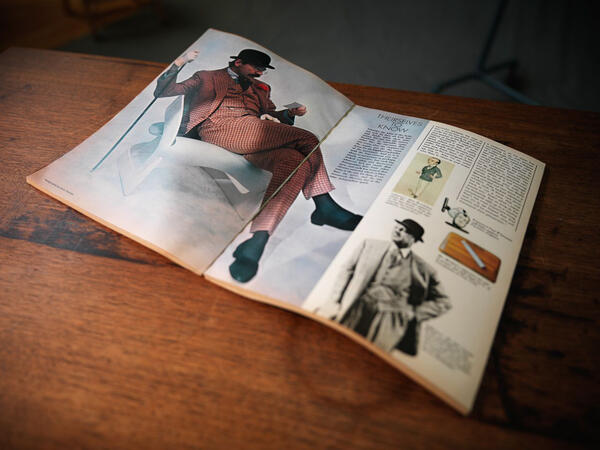
Richard Merkin was for decades the go-to authority for all things dandyish. As we see in the ephemera from his life and his tailored clothing on view in the exhibition "Artist/Rebel/Dandy", his personality and fashion sense live on at RISD.
Egungun costumes are usually created from a wide variety of carefully chosen fabrics ranging from exquisite samples of local handwoven aso ofi to exotic fabrics imported from aro
The RISD Museum’s 2009 acquisition of the Richard Brown Baker collection included two drawings by the English artist Howard Selina—Cowboy Hat (1974) and Two Boots (1974)—carefully and precisely rendered drawings in graphite on paper of well-worn, utilitarian garments.