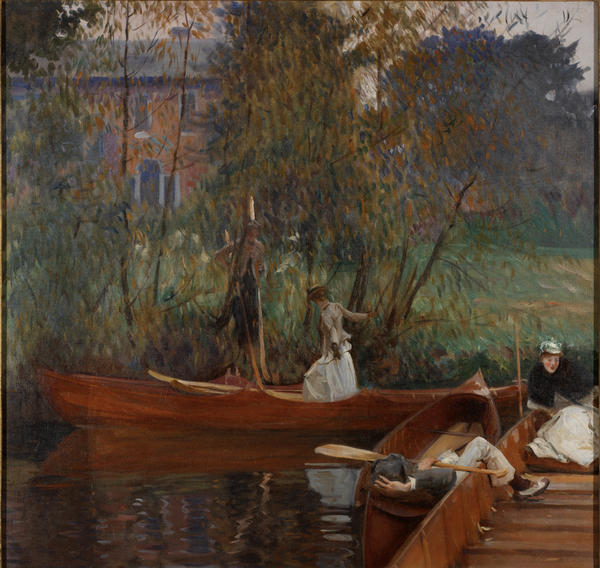
Unfinished paintings by Eastman Johnson, John Singer Sargent and Mary Cassatt reveal new techniques that emerged in France in the second half of the 19th century.
Curatorial assistant of contemporary art A. Will Brown interviews artist Steffani Jemison about her film *Maniac Chase* (2009), *Escaped Lunatic* (2010–2011) and Personal (2014)
For many of us, a line is the first mark we make. It is a huge developmental milestone when a young child's first scribbles are set to the page (or wall!).
Pixilation Party!, or how, with the help of dozens of RISD Museum visitors, Providence artist Xander Marro recently created one minute of black and white magic.
William Stanley Haseltine first studied painting in Philadelphia with the German expatriate Paul Weber, who encouraged him to continue his training in Düsseldorf.Haseltine attended the Univer
The Museum recently acquired *Huevos de Los Angeles*, a collaborative work by two RISD alumni, Adam Silverman and David Wiseman. Here the artists describe how they created "eggs" to rival the most coveted variety.
A student dismantles the outdated terminology and practice of “master copies” by constructing a series of copies that works to bolster underrepresented artists and subvert the pervasive presence of white males in the Western art canon.
Editor of publications Amy Pickworth, intern Joanna Cortez, and curatorial assistant of contemporary art A. Will Brown interview UuDam Tran Nguyen about his single channel video Waltz of The Machine Equestrians--The Machine Equestrians (2012).
Architect James Stanton-Abbott explains his process for creating a computer-rendered reconstruction of a room in an ancient Roman villa near Pompeii, using images of wall-painting fragments in the RISD Museum and the MFA, Boston.
In earlier decades, retouching (or “inpainting”) using reversible painting materials would have been employed where compositional elements were missing.
Arlene Shechet discusses the production of works for and the installation design of Arlene Shechet: Meissen Recast with the exhibition's curator, Judith Tannenbaum.
RISD Museum object photography generally follows typical museum practice: a straightforward approach to framing and lighting with great concern for color fidelity. For *Artist/Rebel/Dandy*, the curators suggested that we go in a different direction.